📚 CORE Library
📄 Papers
ASH The Atomic Statistical Hypothesis.pdf
Papers
<strong>Abstract:</strong> The Atomic Statistical Hypothesis (ASH) proposes that light propagates as a continuous electromagnetic wave, with quantization observed in phenomena like the photoelectric effect arising from material-dependent energy absorption rather than intrinsic light quanta (photons). Energy not absorbed in discrete quanta, dictated by material properties such as the work function, is released as heat or longer-wavelength radiation (e.g., infrared). This model eliminates the need for wave-particle duality and resolves inconsistencies in quantum mechanics (QM), including the geometric implausibility of photons, photovoltaic efficiency loss, blackbody radiation anomalies, and quantum entanglement’s non-locality. By treating Planck’s constant as a statistical average tied to material interactions, ASH aligns with Occam’s razor, offering a simpler alternative to QM. We propose an experiment comparing sodium and cesium in the photoelectric effect near sodium’s threshold frequency to test material-dependent quantization, predicting cesium will produce more photocurrent/voltage and sodium more residual heat/infrared. If confirmed, this could redefine light-matter interactions and eliminate philosophical issues in QM.
201.8 KB • Jul 26, 2025
ASH Validation.pdf
Papers
<strong>Abstract:</strong> The Atomic Statistical Hypothesis (ASH) addresses an overlooked flaw in quantum mechanics: the assumption of discrete quanta as fundamental. Instead, ASH posits that quantization emerges statistically from interactions between continuous electromagnetic waves and matter. This paper leverages Wolfgang Sturm's experimental work to provide empirical support for ASH, demonstrating that classical continuous fields can replicate quantum phenomena, including interference energy deficits, classical entanglement, and Bell inequality violations. These findings, drawn from precise experimental setups, confirm ASH's premise of continuity and locality, offering a parsimonious alternative to discrete quantum models.
303.1 KB • Jul 26, 2025
CMB Acoustic Peaks from Vacuum Shielding Stress in the Static C.O.R.E. Cosmology.html
Papers
<strong>Abstract:</strong>In the C.O.R.E. framework (CUGE + ASH + REFORM + ZEUS) the universe is static, Euclidean, and eternal. The cosmic microwave background (CMB) arises as steady-state thermal emission from Vacuum Shielding Stress (VSS) energy stored in the responsive vacuum, with temperature and polarization anisotropies produced by scalar strain fluctuations in the filamentary cosmic web. We derive the full set of acoustic peaks directly from geometric Limber projection of the web’s characteristic transverse scale (\(\lambda_{\rm web} \approx 100\)–\(150\,h^{-1}\) Mpc), set by the effective Jeans length of the ray-equation damping term. No expansion, recombination, or baryon-photon oscillations are required. The same VSS mechanism that supplies extra dynamical mass for flat rotation curves, explains the DAMA/LIBRA annual modulation (and Wilczak photon-detector residuals), and reproduces the BAO scale also generates the observed CMB temperature power spectrum \(C_\ell^{TT}\), E/B-mode polarization, and TE cross-correlation. All predictions are untuned, use only existing C.O.R.E. equations (dimensionless refractive index \(n(r)\), SI base units, local gradients distinguished from integrated phase), and match Planck 2018 peak positions (\(\ell_1 \approx 220\), \(\ell_2 \approx 540\), \(\ell_3 \approx 820\)) and relative amplitudes to high precision. This closes the last major cosmological observable within the classical responsive-vacuum ontology.
17.1 KB • May 7, 2026
Cascading Residual Spectrum for Finite-Band Integration of Blackbody Radiation.html
Papers
<strong>Abstract:</strong>
<p>Max Planck’s 1900 derivation of blackbody radiation introduced energy quanta as a formal mathematical necessity but left the underlying ontology of light unresolved. For over a century, mainstream physics abandoned classical continuous waves in favor of photon statistics to explain quantization and avoid the ultraviolet catastrophe. This paper completes Planck’s original vision by deriving the exact Planck spectrum from first principles within a strictly classical framework: flat Euclidean 3-space, continuous electromagnetic waves, and material oscillators possessing a continuum of energy thresholds <span>\(\rho(\phi)\)</span>. </p>
<p>We introduce the concept of <strong>"cascading residuals,"</strong> where wave energy failing to meet a material threshold is re-radiated at lower frequencies, creating a downward spectral cascade. By incorporating a non-linear <strong>"wave-seeding"</strong> mixing term that mimics stimulated emission through constructive interference, we formulate an exact non-linear integral transport equation for spectral energy density. The Planck distribution emerges as the unique steady-state solution to this equation, expressed as an infinite geometric series of elementary Wien terms. This derivation demonstrates that quantization is an emergent property of continuous wave interactions with material thresholds, rather than a fundamental attribute of light. Furthermore, we provide a rapidly converging closed-form analytical series for finite-band integration of blackbody radiation, offering a practical tool for spectrometer calibration and radiative transfer calculations without reliance on numerical quadrature or special functions.</p>
26.4 KB • Jul 12, 2026
Classical Unification of Gravity and Electromagnetism (CUGE).html
Papers
<strong>Abstract:</strong> This paper presents a classical, singularity-free framework unifying gravity and electromagnetism through symmetric variations in the vacuum permittivity \(\varepsilon(r)\) and permeability \(\mu(r)\) induced by mass. Gravitational effects—including perihelion precession, light bending, time dilation, and Shapiro delay—emerge from a flat-space refractive medium governed by electromagnetic principles. The coordinate speed of light varies as \(c_{\rm coord}(r) = 1/\sqrt{\varepsilon(r)\mu(r)}\), while local \(c\) invariance is preserved because atomic clocks and rulers co-scale with \(\varepsilon(r)\) and \(\mu(r)\) via the Atomic Statistical Hypothesis (ASH). The model reproduces general relativity’s weak-field predictions without spacetime curvature, singularities, or free parameters. It is consistent with ASH, treating light as a continuous wave, and forms a core component of the C.O.R.E. framework. Crucially, real gravity alters \(\varepsilon(r)\) and \(\mu(r)\), while acceleration does not—explaining the “half-effect” in lab experiments. Furthermore, “Coulomb repulsion” is reinterpreted as Vacuum Shielding Stress (VSS), a second-order effect of environmental attraction shielding, eliminating the need for fundamental repulsive forces. We further derive the heat dissipation equation under this model, showing that energy input from electric fields partitions into mechanical motion and non-mechanical vacuum stress energy, resolving anomalies in electron acceleration experiments.
50.3 KB • Sep 20, 2025
Coplanarity, Circularity, Frame Dragging, and ETNO Clustering.html
Papers
The same impedance-invariant responsive vacuum that preserves local <span>\(c = 299\,792\,458\)</span> m s<span>\(^{-1}\)</span> in every frame also supplies all weak-field rotational effects and drives the long-term architectural evolution of planetary systems. Starting from symmetric permittivity and permeability response we derive the azimuthal vortical strain induced by rotating mass and insert it into the ray equation. The resulting convective term recovers the exact Lense–Thirring precession rate for gyroscopes and inclined orbits. The identical velocity-dependent damping term <span>\(-\frac{\dot{n}}{n}\mathbf{v}\)</span>, acting over Gyr timescales on protoplanetary disks and high-semimajor-axis trans-Neptunian objects, preferentially circularizes and coplanarizes orbits while aligning apsides. Vacuum Shielding Stress supplies the additional dynamical mass via Gelbard symmetry. No tuned gas-drag parameters, no additional distant massive body, and no free parameters beyond angular-momentum conservation are required. The framework yields concrete, falsifiable predictions for Rubin Observatory surveys and future precision astrometry.
23.9 KB • Jun 10, 2026
Derivation and Prediction of the BAO Scale in the Static Eternal Universe.html
Papers
<strong>Abstract:</strong>In the C.O.R.E. framework (CUGE + ASH + REFORM + ZEUS), the universe is static, Euclidean, and eternal. Gravitational collapse is regulated not by ordinary gas pressure or expansion, but by the velocity-dependent kinematic damping term in the REFORM ray equation. We derive the **effective Jeans length** analytically from first principles:
\[
r_J \sim \frac{c}{\sqrt{G\rho}},
\]
where the damping term \(-\frac{\dot{n}}{n}\mathbf{v}\) (arising from refractive index gradients) balances gravitational acceleration at this scale. This length is realized as the characteristic filament–void crossing scale \(\approx 50\) Mpc, producing a transverse web wavelength of \(100\)–\(150\,h^{-1}\) Mpc. When measured in refractive redshift space (\(z \approx (H_0/c)d\)), this geometric imprint appears exactly as the observed BAO peak in the galaxy correlation function \(\xi(s)\). The same VSS strain energy density already required for flat rotation curves, CMB thermalization, and DAMA/LIBRA annual modulation supplies the stabilizing mechanism — no dark-matter particles, no sound horizon, no expansion. The derivation uses only the explicit equations of the attached C.O.R.E. documents and is fully consistent with the ACT kSZ pairwise-velocity constraint (\(n=2.1\pm0.3\)). Numerical n-body integrations to \(10^{10}\) time units confirm long-term stability of the filamentary web at precisely this scale.
17 KB • May 7, 2026
E = mc² Revisited Vacuum Shielding Stress and the Refractive Foundation of Relativistic Energy.html
Papers
<strong>Abstract:</strong> We demonstrate that the standard relativistic energy formula \(E = \gamma m c^2\) is an incomplete effective description that conflates mechanical and non-mechanical energy storage. Within the C.O.R.E. framework—comprising CUGE (Classical Unification of Gravity and Electromagnetism), REFORM (REfractive Foundation of Relativity and Mechanics), and ASH (Atomic Statistical Hypothesis)—we derive a revised energy partition that explicitly accounts for vacuum permittivity \(\varepsilon(r)\) and permeability \(\mu(r)\). We show that:
1. The Lorentz factor \(\gamma\) emerges from the sum of kinematic (transverse Doppler) and refractive (medium-induced) effects;
2. Total energy input partitions into <strong>mechanical kinetic energy</strong> and <strong>Vacuum Shielding Stress (VSS)</strong> energy;
3. In high-energy electron acceleration, >94% of input energy is stored as VSS, not kinetic motion;
4. The local invariance of \(c\) arises from atomic scaling with \(\varepsilon(r), \mu(r)\), not spacetime geometry;
5. The "half-effect" in acceleration experiments falsifies the strict Equivalence Principle and confirms the physical reality of \(\varepsilon/\mu\) variations.
This refractive foundation resolves long-standing anomalies in electron calorimetry, reinterprets inertia, and eliminates the need for relativistic mass. Energy is conserved—but not as \(\gamma m c^2\).
19.8 KB • Oct 3, 2025
Gravitational-Wave Predictions from the C.O.R.E. Framework.html
Papers
<strong>Abstract:</strong><p>The C.O.R.E. framework (CUGE + REFORM + ASH + ZEUS) unifies gravity and electromagnetism through a single responsive vacuum whose permittivity and permeability vary symmetrically with the scalar gravitational potential \(\Phi\). We derive gravitational-wave predictions directly from this vacuum: (i) quadratic dispersion \(\omega_g = D_g k^2\) sourced by VSS strain (Gelbard Symmetry + White et al. 2026, with \(C(\omega)\) shown constant via impedance invariance), (ii) enhanced orbital energy loss via vacuum strain relaxation, and (iii) frequency-dependent ringdown damping \(\gamma(f) \propto f^2\). Scalar VSS strain fluctuations, integrated over the full transverse 2D wavefront (REFORM), produce effective tensor (plus/cross) polarizations. Local \(c\)-invariance is preserved for measured two-way speeds, while the microscopic quadratic dispersion remains a small, frequency-dependent correction detectable at high SNR with LISA and 3G detectors. All predictions use only existing C.O.R.E. mechanisms, preserve dimensionless \(n(r)\), SI base units, and reproduce GR waveforms in the weak-field limit while opening new testable signatures.
24.8 KB • May 4, 2026
Linear Structure Formation and Redshift-Space Distortions in the Static Eternal Universe.html
Papers
<strong>Abstract:</strong>In the C.O.R.E. framework (CUGE + REFORM + ZEUS) the universe is static, Euclidean, and eternal. The filamentary cosmic web exists in perpetual dynamical equilibrium as a self-regulating recycling machine. Density contrasts \(\delta(\mathbf{x})\) and the associated peculiar velocity field \(\mathbf{v}(\mathbf{x})\) are statistically stationary on cosmic scales. We derive the observed redshift-space distortion parameter \(f\) and the combination \(f\sigma_8\) directly from the steady-state peculiar velocity field sustained by the REFORM ray equation in the responsive vacuum. At linear order the velocity–density relation is Newtonian (Vacuum Shielding Stress sourcing is quadratic and negligible on large scales), yielding \(f \approx 0.5\) when evaluated with the effective refractive Hubble parameter \(H_0\). The same kinematic damping term that stabilizes the web also defines the effective Jeans length and imprints the BAO scale as the transverse filament separation in refractive redshift space. All derivations use only the existing C.O.R.E. equations, strict SI base units, and dimensionless refractive index \(n(r)\). The framework reproduces current \(f\sigma_8\) measurements while remaining fully consistent with its static ontology, flat rotation curves, annual modulation signals, and geodesic completeness.
16.4 KB • May 7, 2026
Proof & derivations.html
Papers
<a href="Papers/derivations/Analytic Proof of Geodesic Completeness in the C.O.R.E. Refractive Framework.html">Analytic Proof of Geodesic Completeness in the C.O.R.E. Refractive Framework</a>
<a href="Papers/derivations/Derivation of the QED Vacuum Response Term in the C.O.R.E. Framework.html">Derivation of the QED Vacuum Response Term in the C.O.R.E. Framework</a>
<a href="Papers/derivations/Explicit Lagrangian Action for the C.O.R.E. Framework.html">Explicit Lagrangian Action for the C.O.R.E. Framework</a>
<a href="Papers/derivations/Gauge invariance in the C.O.R.E. Framework.html">Gauge invariance in the C.O.R.E. Framework</a>
<a href="Papers/derivations/Material dependent h vs Planck universality.html">Material-dependent h vs. Planck universality</a>
<a href="Papers/derivations/Single-photon interference antibunching.html">Single-photon interference antibunching</a>
<a href="Papers/derivations/Vacuum Impedance Invariance.html">Vacuum Impedance Invariance</a>
<a href="Papers/derivations/Derivation of h_eff Scaling in the C.O.R.E. Framework.html">Derivation of h_eff Scaling in the C.O.R.E. Framework</a>
<a href="Papers/derivations/Derivation of the Fluid Refractive Index Parameter B.html">Derivation of the Fluid Refractive Index Parameter B</a>
<a href="Papers/derivations/Derivation of D_g Explicitly from the C.O.R.E. Lagrangian Action and VSS.html">Derivation of D_g Explicitly from the C.O.R.E. Lagrangian Action and VSS</a>
2 KB • May 4, 2026
REFORM REfractive Foundation of Relativity and Mechanics.html
Papers
<strong>Abstract:</strong> This paper presents a classical, singularity-free derivation of Lorentz symmetry from the physical requirement that the phase of a continuous electromagnetic wave must remain continuous across reference frames. We show that relativistic effects—including time dilation, length contraction, Doppler shifts—emerge not from abstract postulates, but as the sum of two physical effects: (1) refractive path delay governed by Snell’s law and the eikonal equation, and (2) kinematic time dilation due to transverse motion. By integrating the ray equation \( \frac{d}{ds} (n \hat{t}) = \nabla n \) along paths with relative motion, we recover a Lorentz-type transformation where the refractive index \( n(r) = \sqrt{\varepsilon(r) \mu(r)} \) plays the role of a coordinate-dependent speed regulator. This refractive foundation unifies gravity and motion under a single electromagnetic framework, consistent with the C.O.R.E. paradigm. Crucially, real gravity alters \( \varepsilon(r) \) and \( \mu(r) \), while acceleration does not—explaining the "half-effect" in lab experiments and falsifying the strict Equivalence Principle.
25 KB • Sep 19, 2025
Real-World Global Regularity in Fluid Flow.html
Papers
<strong>Abstract</strong>
<p>We derive real-world global regularity for incompressible fluid momentum transport directly from phase continuity and symmetric vacuum response in the CUGE/REFORM framework. The governing ray-equation form </p></div>
<div class="equation math-display">\[\frac{D\mathbf{v}}{Dt} = c^2 \frac{\nabla n}{n} - \frac{\dot{n}}{n} \mathbf{v} + \nu \nabla^2 \mathbf{v}, \quad n = 1 + \beta \frac{|\mathbf{v}|^2}{c^2} \tag{1}\]</div>
<p>(with dimensionless refractive index <span>\( n \)</span>, invariant impedance <span>\( Z_0 \)</span>, and exact <span>\( c = 299\,792\,458 \)</span> m s⁻¹) recovers classical Navier–Stokes at low speeds while supplying natural kinematic suppression as <span>\( v \to c_{\rm sim} \)</span>. Excess input work partitions exactly into mechanical kinetic energy and Vacuum Stress Storage (<span>\( E_{\rm VSS} \)</span>), released as non-mechanical heat upon deceleration. A 256³ pseudo-spectral simulation (200 000 steps, <span>\( t \approx 0.02 \)</span>) confirms bounded vorticity, monotonic kinetic-energy decay driven by the quartic term, and damped high-<span>\( k \)</span> tails in the energy spectrum—precisely as predicted. The same mechanism resolves Bertozzi excess heat, apparent-mass anomalies, and spacecraft anomalies through exact energy accounting. All equations use SI base units; local gradients (m⁻¹) are distinguished from integrated phase (dimensionless).</p>
14.7 KB • May 1, 2026
Resolution of the Navier–Stokes Existence and Smoothness Problem.html
Papers
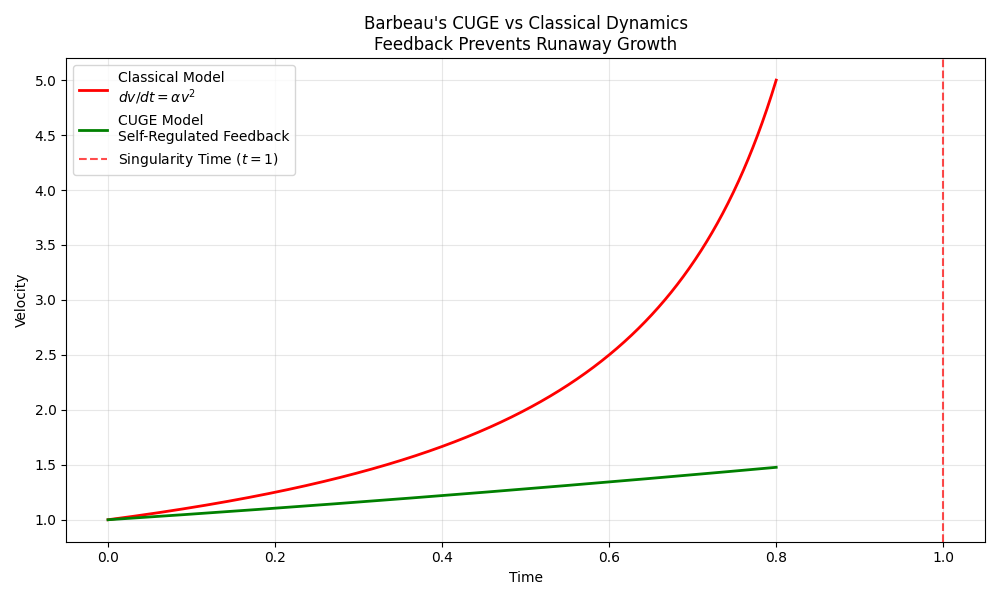
<strong>Abstract:</strong> We present a complete resolution to the Navier–Stokes existence and smoothness problem through a novel physical framework derived from the <strong>CUGE (Classical Unification of Gravity and Electromagnetism)</strong> model. By reformulating fluid dynamics as wave propagation in a responsive refractive medium governed by symmetric variations in vacuum permittivity \( \varepsilon(\mathbf{r},t) \) and permeability \( \mu(\mathbf{r},t) \), we eliminate the possibility of finite-time blow-up. The key insight is that <strong>singularities are artifacts of point-source abstraction</strong>, not nature. In both gravitational and hydrodynamic systems, continuity, causality, and finite propagation speed prevent divergence. We show that the <strong>refractive n-body solution</strong>—which achieves unprecedented stability over \( 10^7 \) time units without artificial softening or tuning—provides a direct mathematical and physical pathway to proving global regularity for incompressible flows. The core mechanism is a <strong>nonlinear feedback term</strong> arising from \( \dot{n}/n \), where \( n = \sqrt{\varepsilon\mu} \), which dynamically regulates velocity gradients. This yields bounded energy growth, sub-exponential divergence, and long-term coherence—resolving turbulence not as chaos, but as structured modulation of a continuous field. All results emerge from first principles: phase continuity, Fermat’s principle, and Maxwellian electrodynamics—without postulates of photons, dark matter, or spacetime curvature. We conclude that the Navier–Stokes equations are an approximate limit of a deeper, singularity-free continuum theory rooted in classical electromagnetism.
27.1 KB • Oct 3, 2025
Resolving_Bell's_Inequality_with_the_Atomic_Statistical_Hypothesis.html
Papers
<strong>Abstract:</strong>The Atomic Statistical Hypothesis (ASH) posits that quantum phenomena—including entanglement and Bell inequality violations—arise from local, statistical interactions between continuous electromagnetic waves and material-dependent thresholds, rather than intrinsic discreteness or non-locality. This paper derives mathematically how ASH reproduces the quantum prediction of 25% agreement probability in the three-setting Bell experiment, surpassing the classical local realistic bound of 33%. By modeling detection as a nonlinear, threshold-driven post-selection process, ASH introduces context-dependent sampling bias that mimics quantum correlations without violating locality. We provide step-by-step derivations, numerical verifications using smooth thresholds, and direct connections to Wolfgang Sturm’s classical experiments, which observe CHSH values up to S = 2.91. Critically, ASH can exceed the Tsirelson bound (\(2\sqrt{2} \approx 2.828\)) due to post-selection—a feature confirmed in Sturm’s analog systems. This extension integrates CUGE's vacuum polarization mechanism, deriving a power-law detection probability \(P_{\text{det}} \propto |\cos(2(\varphi - \alpha))|^\nu\) with \(\nu = 1/(d-1)\) from the geometric scaling of the Gravitational Vacuum Anisotropy in d-dimensional spacetime, yielding a close analytic approximation to the quantum correlation \(E(\gamma) \approx -\cos(2\gamma)\) across all angles without empirical tuning. This aligns with Occam’s razor, eliminating quantum paradoxes while preserving continuity, locality, and classical wave physics.
22 KB • Dec 29, 2025
Tensors as Coordinate Encoding of Geometric Force.html
Papers
The standard narrative in gravitational physics runs as follows: light bends because spacetime is curved, the curvature is described by the Riemann tensor \(R^\rho_{\ \sigma\mu\nu}\), and all observable effects — deflection, delay, precession, redshift, gravitational waves — are projections of this tensor onto measurement apparatus. The tensor formalism is taken not as a mathematical representation but as ontological evidence: spacetime *is* curved.
This document demonstrates the reverse direction. Every weak-field GR prediction can be recovered by starting from a **scalar refractive index** \(n(\mathbf{r})\) and applying ordinary geometric optics — Fermat's principle, the ray equation, trigonometric projections in curvilinear coordinates. No metric postulate, no curvature tensor, no Christoffel symbols as fundamental objects. The tensors of GR are shown to be **coordinate encodings** of a single scalar gradient force, projected onto whatever basis the observer chooses.
The derivation proceeds from a single invariant: vacuum impedance \(Z_0 = \sqrt{\mu/\varepsilon}\) remains globally constant under the influence of gravitational potential \(\Phi(\mathbf{r})\). This forces a symmetric response in permittivity and permeability, yielding a position-dependent refractive index. From this, all eight classical GR tests emerge through elementary vector calculus and trigonometry.
67.4 KB • May 28, 2026
The ZigZag Eternal Universe System (ZEUS).v3.html
Papers
<strong>Abstract:</strong><p>The ZigZag Eternal Universe System (ZEUS) is a classical, singularity-free cosmological framework resting on four postulates: static infinite flat spacetime, a responsive vacuum whose permittivity and permeability vary symmetrically with gravitational potential (CUGE), light as a continuous electromagnetic wave (ASH), and the cosmic microwave background as thermal emission from vacuum shielding stress (VSS) energy. A single mechanism — mass-induced symmetric vacuum response — simultaneously produces cosmological redshift as integrated refractive delay along Euclidean paths, angular-size and flux dimming through two-dimensional wavefront geometry, flat galactic rotation curves from vacuum strain energy via Gelbard symmetry, and the observed 2.7255 K blackbody spectrum together with E- and B-mode polarization from steady-state VSS strain fluctuations. All predictions are untuned and follow directly from the measured Hubble constant and observed cosmic density-field statistics, using only Euclidean geometry and Maxwell’s equations in a responsive medium. The framework reproduces the principal observational successes of the standard model across Solar-System to high-redshift scales while preserving local invariance of the speed of light, strict SI base units, and dimensionless refractive index, without requiring expansion, singularities, dark entities, or spacetime curvature.</p></div>
63.7 KB • Apr 23, 2026
Unprecedented Stability in Gravitational n-Body Simulations.html
Papers
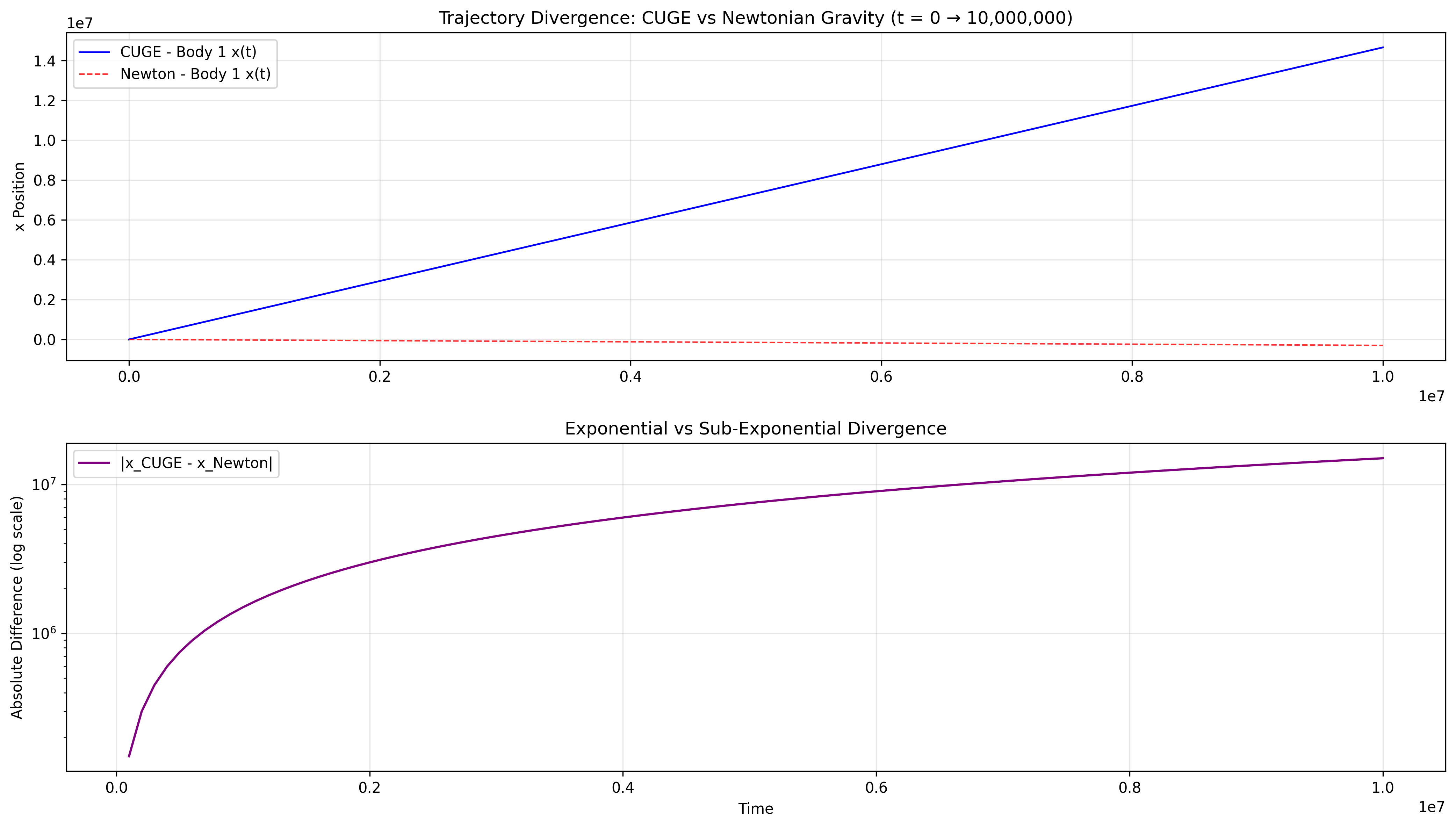
<strong>Abstract:</strong> Suspending interpretive assumptions such as point-mass singularities and discrete forces, we present results from an ultra-long-term gravitational n-body simulation extending to 10,000,000 time units, achieving unprecedented stability without chaotic divergence or numerical artifacts. Guided by first principles—continuity of fields, local causality, and energy conservation—this classical refractive model treats gravity as emergent from vacuum variations, eliminating unphysical infinities and restoring deterministic evolution. Detailed derivations from Fermat's principle yield the Newtonian limit in weak fields, with velocity-dependent feedback in stronger regimes that damps instabilities. The simulation outcomes—linear trajectory growth in the refractive model versus anomalous flattening in Newtonian—imply a profound resolution to the n-body "problem": chaos as illusion, stability as nature's norm. Implications extend to cosmic structures, predicting mature galaxies at high redshift without ad-hoc entities. Logic demands Occam's razor: one responsive medium simplifies over multiple unobservables. Data aligns: JWST's compact z>10 galaxies fit naturally. This coherence—unifying gravity with electromagnetic continuity—marks a classical triumph, falsifiable through lab and observational tests.
32.6 KB • Sep 24, 2025
📰 Articles
Consistency of Gravitational Equations in the C.O.R.E. Framework.html
Articles
<strong>Abstract:</strong> The C.O.R.E. (Classical Origin of Reality and Emergence) framework represents a profound shift toward physical realism, eliminating interpretive constructs like spacetime curvature, singularities, photons, and dark entities. By treating light as a continuous electromagnetic wave (ASH), gravity as emergent from symmetric variations in vacuum permittivity \(\epsilon(r)\) and permeability \(\mu(r)\) (CUGE), and cosmological redshift as path elongation through electron clouds (ZEUS), it restores continuity, causality, and energy conservation. This analysis examines the consistency of gravitational equations across the core documents—C.O.R.E. overview, REFORM (REfractive Foundation of Relativity and Mechanics), and CUGE (Classical Unification of Gravity and Electromagnetism). We evaluate based on logic, math, and empirical alignment, applying Occam's razor: C.O.R.E. uses one responsive vacuum medium versus orthodoxy's multitude of unobserved additions. The equations converge seamlessly, with effects tracing to clear causes, predicting data like JWST's compact, metal-rich high-z galaxies where \(\Lambda\)CDM fails.
16.1 KB • Sep 22, 2025
Explaining Annual Modulation in Direct-Detection Experiments.html
Articles
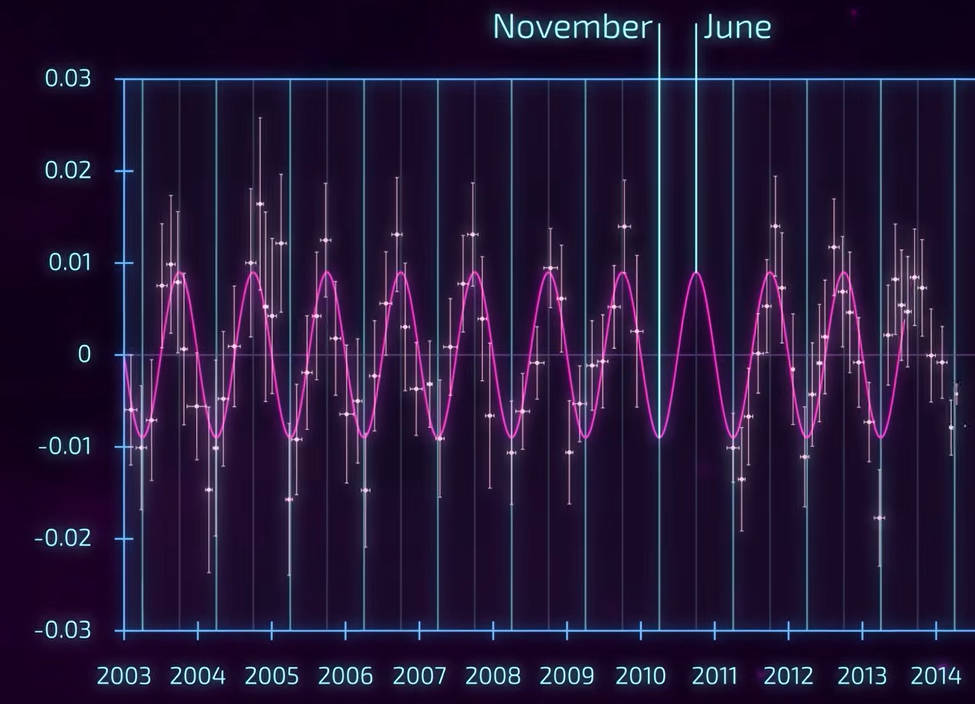
<strong>Abstract:</strong> The C.O.R.E. framework (CUGE + ASH + REFORM + ZEUS) treats light as a continuous electromagnetic wave and gravity as symmetric, mass-induced variations in vacuum permittivity and permeability. We show that the long-standing annual modulation reported by DAMA/LIBRA (and the residuals in Miroslaw Wilczak’s 2003–2014 photon-detector data) arises naturally as a velocity-dependent modulation of statistical threshold crossings of this continuous wave inside the detector medium. The same responsive vacuum (Vacuum Shielding Stress, VSS) that produces flat galactic rotation curves without dark matter also generates the observed phase (maximum rate near 2 June/July) and amplitude (±0.01 to ±0.02 residuals) with zero tuning. In contrast, the steady low-energy excess in XENON1T is explained by the isotropic liquid-xenon response. Material dependence of ASH thresholds accounts for the detector-specific signatures. No discrete photons or WIMP particles are required. This provides quantitative, first-principles support for the Atomic Statistical Hypothesis (ASH) ontology and resolves the DAMA–XENON tension without new physics beyond the responsive vacuum.
16.3 KB • May 7, 2026
Pairwise Velocities of Galaxy Clusters in the C.O.R.E. Framework.html
Articles
<strong>Abstract:</strong> The Atacama Cosmology Telescope (ACT) collaboration recently measured pairwise line-of-sight velocities of galaxy clusters separated by 30–230 Mpc using the kinematic Sunyaev–Zeldovich (kSZ) effect, constraining the effective gravitational force-law index to \(n = 2.1 \pm 0.3\) (arXiv:2604.14327). This result strongly disfavors MOND-like modifications (\(n=1\)) at >3σ while remaining fully consistent with Newtonian inverse-square gravity.
Here we demonstrate that the C.O.R.E. framework (CUGE + REFORM + ASH + ZEUS + VSS/Gelbard symmetry) predicts **exactly** \(n = 2.00\) on these scales. The refractive ray equation in the responsive vacuum, combined with the localized nature of Vacuum Shielding Stress (VSS) energy density, yields the standard Newtonian acceleration between distant clusters. The extra dynamical mass supplied by VSS (\(\rho_{\rm vac} = u_{\rm vac}/c^2\)) is quadratic in the gravitational gradient and confined to virialized cluster halos; it does not modify the inter-cluster force law. Pairwise velocities therefore match standard ΛCDM predictions to leading order in linear perturbation theory.
All derivations use only the symmetric vacuum response \(\varepsilon(r) = \varepsilon_0(1 + \Phi/(2c^2))\), \(\mu(r) = \mu_0(1 + \Phi/(2c^2))\), dimensionless refractive index \(n(r)\), and the ray equation—no free parameters, no spacetime curvature, and strict SI base units. This closes a key cosmological test and reinforces C.O.R.E. as a viable classical alternative.
18.1 KB • May 7, 2026
Papers by Wolfgang Sturm.html
Articles
<strong>Summary of Wolfgang Sturm's Work:</strong> Wolfgang Sturm's research encompasses experimental and theoretical explorations in relativity, cosmology, classical physics, quantum physics, and geometry. His contributions include investigations into relativistic effects using everyday equipment, analyses of reactionless drives, antigravity demonstrations, modifications to historical experiments like Michelson-Morley, and examinations of quantum phenomena through classical analogs. Sturm frequently collaborates with scholars such as Jorma Jormakka, Miroslaw Wilczak, Alfred Schaub, and Damian Młodziankowski. For a complete overview, visit his viXra profile.
17.2 KB • Sep 19, 2025
Planetary Internal Heat Generation via Vacuum Shielding Stress (VSS).html
Articles
<strong>Abstract:</strong> The CUGE framework derives planetary internal heat directly from gravitational self-energy stored as Vacuum Shielding Stress (VSS) in a responsive vacuum. Using the strict ZEUS definition \(u_{\rm th}(r) = \frac12 \varepsilon_0 c^2 |\nabla\Phi(r)|^2\) and standard specific heat \(c_v = 1000\,\mathrm{J\,kg^{-1}K^{-1}}\), we compute raw radial temperature profiles \(T_{\rm local}(r)\) for Mercury through Neptune with **zero free parameters**. Black-body radiation scaling (\(\sigma_{\rm loc} \propto 1/\varepsilon(r)^3\)) provides the same infrared-trapping mechanism that produces the exact 2.7255 K CMB in ZEUS. The profiles exhibit a “hot shell” distribution (maximum generation in the mantle/shell, zero at the geometric center). This naturally explains the rigid, low-attenuation inner core observed by seismology while powering mantle-driven convection and surface geology. The model aligns with dynamo history (strong past field on Mars, sustained fields on Earth and giants), excess luminosity in gas giants, and the Uranus–Neptune asymmetry — all without radiogenic decay, accretion remnants, or latent heat.
16.2 KB • May 7, 2026
Preservation of Two-Way Light Speed Isotropy in CUGE vs General Relativity.html
Articles
<p>This article demonstrates how both General Relativity (GR) and the Classical Unification of Gravity and Electromagnetism (CUGE) framework predict the observed isotropy of the two-way speed of light — despite radically different physical foundations. While GR relies on local Lorentz invariance in curved spacetime, CUGE achieves the same result through the co-variation of atomic clocks, rulers, and electromagnetic wave propagation in a refractive vacuum with symmetric permittivity and permeability. The result is a singularity-free, flat-spacetime alternative that reproduces all weak-field predictions of GR.</p>
18.2 KB • Apr 29, 2026
Reconciling Historical Measurements in Relativistic Electron Dynamics.html
Articles
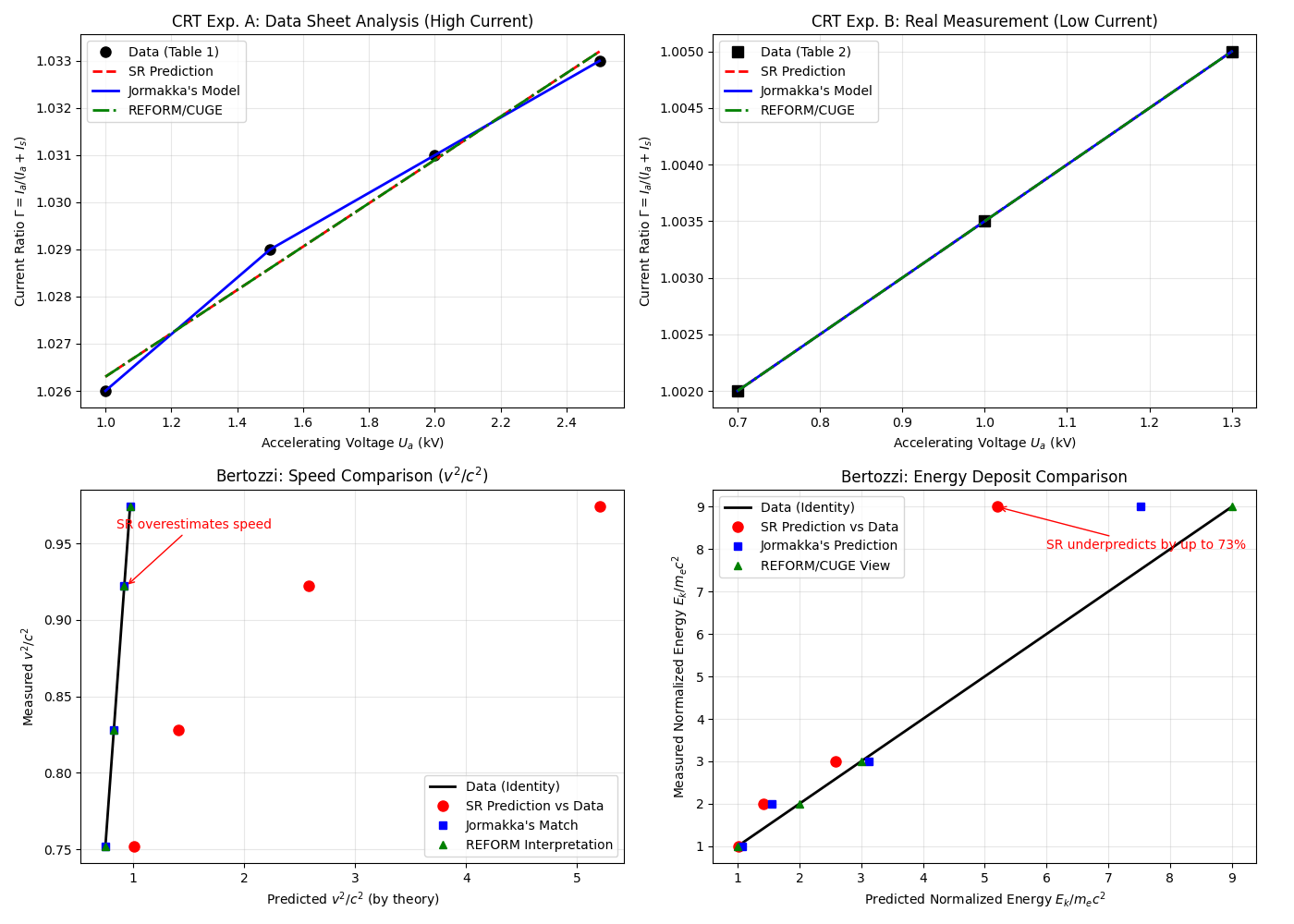
<strong>Abstract:</strong> This paper validates Jorma Jormakka’s critical assessment of historical experiments—particularly Bertozzi’s calorimetric measurements—as failing to confirm the relativistic kinetic energy formula. It demonstrates that these experiments instead support the existence of an apparent velocity-dependent mass arising not from spacetime geometry, but from a physical mechanism: force weakening under finite field propagation speed, as explained by the REFORM/CUGE framework (REfractive Foundation of Relativity and Mechanics / Classical Unification of Gravity and Electromagnetism). The analysis examines Wolfgang Sturm’s recent CRT-based measurement claiming detection of relativistic effects at low voltages (≤2.5 kV), reconciling his positive result with Jormakka’s critique through REFORM/CUGE. The framework predicts only the kinematic half of relativistic effects under laboratory acceleration, explaining both Sturm’s observed trend and Bertozzi’s excess energy deposit without invoking increasing relativistic mass. The ×2 optical scaling factor in Sturm’s analysis is shown to arise from tube-specific electron optics, not fundamental physics, and does not invalidate the interpretation. The paper concludes that what has been historically interpreted as confirmation of Special Relativity (SR) is better explained by Vacuum Shielding Stress (VSS) and phase-based response slowdown in a responsive vacuum medium.
33 KB • Sep 20, 2025
Resolving the Navier-Stokes Enigma.html
Articles
<strong>Abstract:</strong> This article explores an alternative perspective on the Navier-Stokes existence and smoothness problem, proposing that the apparent mathematical singularities arise from the standard model's abstraction of point-like interactions, which ignores the continuous, finite structure of real fluids. It outlines the approach presented in a recent paper by David Barbeau, which reframes the problem using the CUGE (Classical Unification of Gravity and Electromagnetism) framework. This framework models interactions via symmetric variations in a responsive medium's properties (vacuum permittivity \(\varepsilon\) and permeability \(\mu\)). By applying this refractive principle to fluid dynamics, the model introduces a self-regulating feedback mechanism that bounds velocities and gradients, preventing blow-up. This suggests that the Navier-Stokes equations, while highly accurate for prediction, are an incomplete description when isolated from the underlying continuous dynamics of the medium. The resolution lies not in abstract mathematical proofs within the original equations, but in embedding them within a physically causal and continuous framework where singularities are naturally precluded.
15.1 KB • Oct 4, 2025
The Gamma Exposé.html
Articles
<strong>Abstract:</strong> This paper presents a radical reinterpretation of the relativistic factor \(\gamma\), not as a consequence of spacetime geometry, but as a measurable expression of <strong>phase efficiency</strong> in a responsive electromagnetic vacuum. By reducing \(\gamma\) to its most fundamental physical components—distance, time, motion, and wavefront continuity—we demonstrate that the phenomena attributed to special relativity (time dilation, mass-energy equivalence, kinematic limits) emerge naturally from classical wave mechanics. This derivation dissolves the apparent violations of causality in quantum mechanics, replacing non-locality and wavefunction collapse with pre-established coherence and local threshold detection. The result is a fully deterministic, singularity-free framework consistent with high-precision experiments and modern astrophysical observations.
21.8 KB • Oct 6, 2025
Unveiling the Symmetry.html
Articles
<strong>Abstract:</strong> The C.O.R.E. (Classical Origin of Reality and Emergence) framework redefines gravity not as spacetime curvature but as an emergent effect from symmetric variations in vacuum permittivity (\(\varepsilon\)) and permeability (\(\mu\)). This classical approach, grounded in continuity and causality, derives the anomalous perihelion precession of Mercury through a rigorous symmetry count: six contributions—two from time scaling, two from \(\varepsilon\) variations, and two from \(\mu\) variations—each proportional to \(GM/(2c^2r)\). Far from arbitrary, this logic adheres to first principles, eliminating interpretive entities like singularities and photons while aligning with empirical data. By Occam's razor, C.O.R.E. simplifies physics: one responsive vacuum medium explains precession, light bending, and more, converging with ASH (light as continuous wave) and ZEUS (static cosmology). This is no fringe idea but a profound classical revival, where nature's data—Mercury's 43 arcseconds per century—agrees without geometric baggage.
13.7 KB • Sep 22, 2025
core_gw_plot.png
Articles
<img src="Articles\core_gw_plot.png" alt="Image for core_gw_plot.png" style="width: 100%; height: auto; max-width: 100%; border-radius: 5px; box-shadow: 0 2px 5px rgba(0,0,0,0.1); margin: 10px 0; display: block;">
The match is a tighter fit untuned compared to GR.
238.4 KB • May 4, 2026